Home | 2006 (page 2)

Yearly Archives: 2006

PC Repair Franchises

Here is an article discussing 10 tips on making it in the PC repair business.

Most important tips (#2 and #5)…

#2. Determine who your ideal customer is. If you’re looking to sell and service computers within your local community and remain a one-person operation, residential clients may suit you best….If you decide to target the non-residential market, think small. “Niching is one way to go,” says Reaves.

  • My comment: If you are going to put any serious time into this business, you need to understand what strategy will give you the most return on your time. Are you going to offer an innovative service in a growing market segment that meets an otherwise unmet need? You better!
  • Do you have the people skills to sell your consulting services through networking and intelligent promotions? If not, either take in a partner who can sell or stick with your day job.

#5. Market your business everyday…. “I easily put in five to 10 hours a week of promotion,” says Jason Kaufman, owner of Computer Troubleshooters of Mamaroneck, New York. “This doesn’t mean just sitting at a desk, punching out press releases. You’ve got to get your face out there, go door to door if you have to, to let people know you exist. If you’re bashful–not comfortable putting yourself out there or handling rejection–you might find this business isn’t for you.”

  • My comment: Contrary to popular belief, a franchisee has to work just about as hard to make a their franchise profitable as an entrepreneur going the non-franchise route.  Generating (1) sufficient free cash flow and (2) within a few years generating a 12%+ return on invested capital are two metrics partly dependent upon sales.  Inability to generate enough sales to justify continued investment in a business is the leading reason why small businesses close their doors.

I disagree somewhat with #1. Know your street (and hourly) value.

  • My comment: Why do I disagree? Because by nature people prefer predictable, flat-fee pricing as opposed to hourly pricing, especially for individual and small business clients who are much more price sensitive. And when you are starting a new business, you want customer to make a quick decision and remove hesitation that an hourly pricing model will generate (Will this guy screw me? What if he works 1.5 hours, will he be honest?) My father recently went to a computer repair shop to get his laptop keyboard fixed. If the guy said, “I’ll charge you $100/hour and it may take me 1-2 hours.” That is way too open ended and would have walked out with that response. Instead, the computer repair guy said, “I’ll order the part and install it all for $100.” That appeared fair, and my father accepted the offer.
  • Calculating how much personal income you’ll need to pull out of the business is a different consideration.

Quiznos franchisees file class-action fraud lawsuit

Another group of franchisees accuse Quiznos of fraud:

A group of Quiznos franchisees have filed a class-action lawsuit against the Denver sandwich chain in U.S. District Court for the Eastern District of Wisconsin.

The lawsuit alleges that Denver-based Quiznos has “systematically defrauded its franchisees in a scheme designed to build the brand at the expense of its operators in the field.”

The suit contends that the company forces franchisees to buy food and supplies from Quiznos or its affiliates at inflated prices while setting retail prices so low that franchisees can’t profit. The lawsuit also alleges that Quiznos omits or misrepresents key facts about its business operations when selling franchises.

Link to another background article.

Link to previous Quiznos articles on Franchise Pundit

Employee Management – constant, gentle pressure

Another good article in Inc. describing one restaurateur journey to discovering how to successfully manage his ever-changing restuarant staff. 

The startegy is illustrated by the conversation of two restaurant owners.  One restaurant owner is teaching the other about human behavior and tendancies, and he does this by asking the other owner to place the salt shaker in the exact center of the table…it takes several tries before he even comes close to the center.  The point?

Until you understand that [people’s perception of the where the center of the table is located is different], you’re going to get pissed off every time someone moves the saltshaker off center. It is not your job to get upset. You just need to understand: That’s what they do. Your job is just to move the shaker back each time and let them know exactly what you stand for. Let them know what excellence looks like. And if you’re ever willing to let them decide where the center is, then I want you to give them the keys to the store. Just give away the f—in’ restaurant!” 

…Leave any one element out-constant, gentle, or pressure-and you are far less effective…

It’s my job, and consequently the job of every other leader in my company, to teach everyone who works for us to distinguish center from off center and always to set things right. I send my managers an unequivocal message: I’m going to be extremely specific as to where every component on that tabletop belongs. I anticipate that outside forces, including you, will conspire to change the table setting. Every time that happens, I’m going to move everything back to the way it should be. That’s the constant aspect. I’ll never recenter the saltshaker in a way that denies you your dignity. That’s the gentle aspect. But standards are standards, and I’m constantly watching every table and pushing back on every saltshaker that’s moved because excellent performance is paramount. That’s the pressure.

The end result:

Ultimately, of course, the purpose of constant, gentle pressure is less to eliminate problems than to create a staff that is expert at finding imaginative solutions to address your business’s problems–creating a system that can anticipate and accommodate the patron who arrives late for a reservation, for example. Lasting solutions rely on giving appropriate team members a voice, as well as responsibility for making decisions. There is definitely an art to this inclusive type of leadership. It can take a lot more time than leadership based on “my way or the highway.” It demands dialogue, compromise, and a willingness to share power.

Employees want direction, often specific steps and direction on how to perform their job.  Feedback helps employees refine their techniques and deliver what you, as the owner, wants.

Franchise Alternative

Life is Good has another simpler method of selling its t-shirts to the public instead of using corporate owned or franchised storefronts (Inc. magazine):

The ubiquity of its products notwithstanding, Life Is Good doesn’t want to be Starbucks. The Jacobses detest the homogenization of retail that is turning downtowns into Stepford zones and possess an abiding affection for the mom-and-pops that have always been their backbone. Rather than Gap-ify, they plan to open no more than five to 10 corporate stores in total.

But without a glut of company stores, Life Is Good had no widespread physical showcase for its eclectic product line, which fills a 136-page catalog and includes tire covers, picture frames, and dog toys. Franchising would send the iconoclastic Jacobses down cookie-cutter lane and entail the assumption of legal liabilities; in addition franchisees couldn’t benefit from corporate advertising, given that Life Is Good doesn’t do any. So the brothers hit upon an intriguing alternative: Genuine Neighborhood Shoppes. A GNS is an independently owned and operated business that sells Life Is Good products and nothing else. GNS owners get some signage, a 10 percent discount on merchandise, a few exclusive products, and as much or as little help setting up stores as they desire. They pay no franchise fees, but they do agree to propagate the Life Is Good philanthropy model (more on that later) in their communities. The company expects to eventually have 300 such stores; there are now 40, most run by retailers who have a history with the company or by former or current Life Is Good employees.

So, for example, Shannon and Michael Bourassa and Shannon’s brother Sean Patel recently opened Blue Monkey Trading Co., a GNS in Tucson. The Bourassas are steeped in Life Is Good culture–Michael has worked there for five years and is head of the receiving department–so they eagerly accepted the company’s help with layout, merchandizing, website art, signage, and fixtures. “We really haven’t come up with much ourselves,” says Shannon Bourassa, who handles the finances from the couple’s home in New Hampshire while her brother manages operations in Arizona.

Bob Ehrlich, by contrast, designed his own layout and décor for Simply Comfortable, a GNS in Lahaska, Pennsylvania. Ehrlich needed flexible shelving to accommodate a very small space and chose white fixtures to make the products’ colors stand out. (Life Is Good favors natural wooden floors and walls made from dismantled barns.) “They’re up in New England so they have a somewhat different point of view, but they looked at my plans and understood what I was doing,” says Ehrlich.

“I think this notion of avoiding the cookie-cutter approach is cutting-edge, like mass customization where you’re able to adapt something to a local market,” says Frank Hoy, director of the Centers for Entrepreneurial Development, Advancement, Research and Support at the University of Texas at El Paso. “It also gives both the licensing company and the licensee more flexibility in their relationship.” The cost is in control, says Hoy. As GNSs proliferate, “they will end up with more people in their network they don’t know, and so trust counts for less.”

While the franchise-less approach to distribution is not new, it should remind folks that buying a franchise is not the only way to enter into a paved path to small business ownership.

Miscellaneous Links

Seafood restaurant owner – “We’ve had a decent to-go business, but nowhere to put the to-go orders,” Chase said. “It was a 30-minute to two-hour wait in the summer. It was hard to get a space to sit.”

As she pondered solutions, she called Outback Steakhouse, who took her order, asked for details on her car and told her to park in a specialized location. Once she did, a camera notified wait staff to walk out with her order and take her money. It was effortless.
Inspiration struck the seafood restaurant owner, and it smelled like beef. “I sat there and laughed,” she said. “I thought, ‘This is my answer. What am I thinking?’ So it just went from there, and we fine-tuned it from there.”

Instituting the same to-go program as the 915-restaurant chain, Adams unknotted the bar’s tangled crowd flow. Take-out orders swelled from a few dozen to 130-170 orders during season.

When Your Corporate Employer Offers the Buyout

Should you take the buyout? This NY Times article profiles several middle-aged (50ish) people who left the employ of large public companies. What do you do next?

I always enjoyed reading articles about how people evolved into becoming franchisees.  The article starts –

THEY were all on different career paths, but they had one thing in common. In midlife, well before they were ready to retire, they decided to take buyout packages.

The first person profiled is a former attorney and senior executive from JP Morgan Chase who earned a “six figure” income. She is now happier in her role as a not-for-profit director helping women over 50 network. Her friend’s advice was, “All the truly interesting jobs pay under $75,000/year.” I’m sure that is true for many high paying occupations that are not entrepeneurial in nature.

The second profile is that of a former Delta pilot and current owner of an office supply franchise in Las Vegas.

“My wife has a good job as an administrator for the school district.” He hopes to pay himself a salary at the franchise soon.

“There’s a phenomenon called the ‘wealth illusion’ when people get a lump sum in a buyout,” he added. “Have they really assessed, ‘Can I do my own business?’ If they’re going to open a franchise, is there really a need? You end up in a posture where the actual economic status of most people is way, way off what you would assume from all that retirement advertising.”

For Mr. Vance, the risks of starting a business seemed lower than the near-certain disaster of staying at Delta. For now, as he tries to expand his franchise, he is also flying for a company that provides jets to executive travelers. It is not the life he envisioned when he joined Delta, nor is it the one he feared when the company started to shake.

He is not able to save much for retirement, he said. But after living for so many years in the air, “I’m finally able to get involved in things like the chamber of commerce, and I got to know my neighbors, so in that sense it’s been pretty nice. I grew up on a farm in Kentucky, so I’m no stranger to hard work.”

…the final paragraph about the renewed connection to your local community is an often overlooked intangible benefit of owning a franchise.

Common Areas of Dispute

Interesting article in the Dallas Morning News highlighting common “disagreement” points between franchisees/franchisors.

This week, Pizza Inn Inc. said it is being sued by former franchisees who say the company, based in The Colony, “intentionally and negligently misrepresented development and operation costs.”

Subway parent Doctor’s Associates Inc. faces two lawsuits filed this summer stemming in part from a fight for control of the brand’s advertising dollars….

Chris Bray, a franchisee of the Denver-based Quiznos brand, complained of what he views as a lack of communication between franchisees and headquarters….

Most [of Quiznos’ disclosed litigation in the UFOC] involve claims the franchisees say were made about exclusive territories or the inability to get their outlets open within the required time.

Hat Tip: Paul Steinberg in the forum

Investing in Private Placement Offerings (Part 1)

cashI’ve spent most of past year working full time for a private equity and asset management firm. I thought I knew a lot about the private investment world before I started (I’ve been part of several business that received venture capital funding), but what I learned has been a tremendous eye-opener, particularly in seeing the naivity of investors.

My job involves handling and fixing issues (legal, financial, complaints, compliance, etc) that involve hundreds of investors. I often speak to investors when they have concerns or complaints.

I have a lot to say on this topic because I slap my head almost daily at the mistakes, misconceptions, and wholly amateur approach investors make when deciding whether to invest in my company’s real estate related investments and funds. This will be a multi-part series of postings that will be equally relevant to those looking at investing in private placement offerings and those looking to be a franchisee. The no-bologne, no excuse due diligence an investor in a private partnership should go through before locking themselves into an investment is nearly the same a potential franchisee should go through before locking themselves into a franchise.

Venture capitalist often repeat that they do not invest in “ideas”, but rather they invest in the “people”. I always hear that them say they’d much rather have a “C” idea ran by an “A” team, than an “A” idea ran by a “C” team. Focusing on the “people”, the franchisors or general partners, is indeed key from what I’ve seen. How well do you really know the people and managers you’ll be investing with? Have you done a background check on the managers? Have you asked for audited financials this deal and other deals? If they aren’t audited by a reputable firm, walk away…don’t believe the “we didn’t feel it was worth the money” crap excuse. Have you asked for the underwriting documents? If the deal is a preferred return structure and the general partner has built in equity to pay you the full preferred return for a certain period of time, do you know what that time frame is? Are they going to borrow money to pay your distributions? If you don’t know what I’m talking about, you are a fool to invest in a private offering deal no matter what they promise or claim is their past success.

Many complaints stem from misaligned expectations. In my view, the overly positive expectations of investors are their own fault for not doing enough investigation and due diligence. I once watched Jim Cramer from CNBC’s Mad Money show say, “I’d never invest in non-regulated securities (private offerings) because I want the protection.” Cramer formerly offered private offerings through his hedge fund too, so it’s a lot for him to admit that.

What people (potential investors or franchisees) seem to loose is their skeptical prudent eye when they feel comfortable with the salemen. You do know that your salesman is being paid a commission based on he get you to invest, right? You know some firms pay 10% or more to their brokers, don’t you? Do you know where that 10% commission is paid from exactly…it will comes out of your investment even if it is not represented in your capital account as such, so the partnership has to recover your commission to get you back to whole. The salesmen usually only knows enough details about the project to talk about it superficially, so his virtual “guarantees” are baseless beyond his own impressions.  Get to know these facts and be comfortable with their implications, please.  And for crying out loud read the darn PPM (private placement memorandum) and operating agreement (LP or LLC agreement), and have your lawyer review it with you in detail. 

Often in the world of private offerings, you meet the salesmen (broker or finder) from your religious organization, through mutual friends, clubs or other referal. Does that mean you should take their word without your own “real” research? Of course not.

Private placement offerings are (supposed to be only) offered through registered NASD broker/dealers, and these registered representatives are a very regulated group with stiff penalties for saying or promising too much.  If the person hasn’t taken the NASD tests to be certified (usually a Series 7, Series 63, or Series 82) and a member of an NASD firm.  However, firms often bypass the registered rep requirement by paying a “finder’s fee” to the person who made the introduction of the investor.

I will write later about what “real” due diligence and research consists of for the investor/franchisee. Out of the hundreds of investors I’ve seen at my company, in my opinion not one individual person has done enough due diligence before writing that big (sometimes multi-million dollar) check.

Part-time Work = Part-time Profit?

cashHere is a laser skin care franchise that is pitching itself as a viable part-time business. Sounds good, eh? The franchisor is implying that you can work part-time hours and earn full-time profits. How then does the franchisor make money? By upcharging you on the equipment you must buy and subsequently rent, earning a % on each rental deal you source, charging a $30,000 franchise fee, and charging a flat-monthly royalty that is highest when you first start. The franchisor seems to be in a great position to profit in the first two-years regardless of whether you ultimately succeed.

After becoming a LaserShare franchisee, you will purchase the equipment from a specific vendor that we refer you to. The next step is to identify medical practices or other potential business to enter into, what we consider, is a unique long term “revenue sharing lease” and marketing arrangement with. Once, the “revenue sharing lease agreement” is entered into with the medical practice or other business, the practice or business will provide the space for the laser equipment as well as providing the operators of the equipment, most of whom will usually be members of their staffs already. As the LaserShare franchisee, you will provide the laser equipment, marketing/advertising assistance, and initial guidance in launching or expanding the laser skin care component of their practice or business. And, you may set up as many relationships as you like, thereby increasing the utilization and the number of revenue sharing relationships.

Does this sound like a casual, part-time opportunity?

We have tried to keep it simple. You pay a one time fee upfront of $30,000 and a FLAT monthly royalty, not tied into sales or other revenue volume that declines substantially over the first 24 months to a small one time annual fee starting in Year Three.

Return on your investment and time, in addition to individual lifestyle choices, are the primary reasons most people buy into a franchise system. Before you buy into a franchise, always look at the tradeoofs…evaluate your dollar investment, time investment, likelihood of success based primarily on discussions from those already selling similar product to your customers, and how much money you would need to net for this business to be worthwhile.  Compare that risk with a safe choice, such as taking a lower paying job that you enjoy and investing the franchise fee and other upfront costs in safe passive investments earning 6-8% per year.  Is the franchise worth the risk?  Is it only worth the risk if you buy multiple units?  You must know the answers to these questions.

Eating in the Car

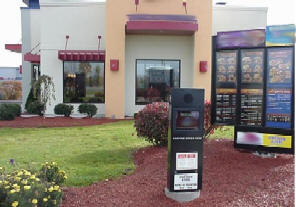
tacoI’m embarassed to admit that I’m a fan of drive-thrus, and I’ve perfected eating while driving with my knees since I drove to high school. When you think of drive-thru, however, you normally don’t think of healthy meals, unless you want to go low-carb and just slop down the burger meat.


QSR mag released a survery of consumer preferences related to drive through. Here are some highlights:

56% eat quick-serve food at least once each week, while 39% use the drive-thru at least once a week. Another 25% said they use the drive-thru once or twice per month.

63% of consumers we surveyed agreed or strongly agreed with the statement, “I want food that is easy to consume in a car.” And 15% said, “I only shop at restaurants with a drive-thru.”

57% said an acceptable wait time was no more than five minutes….23% indicated they would wait up to ten minutes, while 11% said they would wait for one or two minutes.

46% indicated that their food choices differ when they are ordering at a drive-thru, compared to when eating inside the restaurant

The survery makes a good case to favor restaurant franchises with drive-thrus, especially when 39% of the people surveyed eat at the drive-thru weekly.

This always puzzled me – why isn’t their more drive-thru pizza by the slice restaurants? Sbarro’s drive thru, perhaps?

Printing Money?

Excellent article reviewing the major print franchises.

Franchise No. Locations Net Loss/Gain Systemwide Sales ($ million) Net Loss/Gain Avg. Per Store Sales ($000) Net Loss/Gain
Minuteman 915 +13 $375 +25% $524 +1%
Sir Speedy 487 -25 $380 -5% $700 0%
Allegra 416 -32* $265 -2.1% $654 +6.7%
AlphaGraphics 277 -6 $224 -9.9% $1,002 +2%
PIP 276 -21 $127 -1.7% $458 +5.4%
Kwik Kopy Printing 220 -21 $309 +5% $510 +11.3
Signal Graphics 37 -2 $15 -0.5% $416 +2.6%
LAZERQUICK 34 -2 $19 +7.3% $577 +17.3%
Franklin’s 30 -6 $17 -9.7% $715 +25%
Ink Well 29 -5 $14 +1.9% $512 +8.9%
Triangle 16 0 $13.5 -3.6% $850 -2.9%
Kwik Kopy Business Center 16 +5 $3.4 +53.9% $288 +0.7
Copy Club 11 -9 $8 -74.3% $800 +3.3%
TransAmerica Printing 10 -1 Not Reported

* source: Cary Surburne @ WhatTheyThink.com

Our company recently purchase several boxes of envelopes with our logo and it cost us more than $1,400.00. While the quality is good, that’s quite a markup for short-notice printing.

How will these companies compete with Internet monsters iPrint and VistaPrint, who can provide equal quality at fractions of the price? I’ve used the online printers with outstanding results. But, I think the local printing industry will do just fine and will eventually innovate as necessary to stay competitive.

“Companies in the printing space that seem to be doing the best are those that have embraced technology and leveraged the convergence factor to expand the range of services they are offering, like the FedEx Kinko’s printing/shipping concept. If the franchisee has been making money and the company they are with has been successful in supporting them, making that leap to renewing is an easy one.”

Hat tip: Paul Steinberg in the forum

The Moving Industry is Moving

podsThe past decade has seen substantial innovation and entrepreneurship in the moving industry.

As a general observation, there seems to be ample opportunity for franchise success in the trades and laborer market. The public typically responds to recognizable franchise names in an otherwise disorganized industry (see Roto-Rooter, MerryMaids, Handyman Network, Two Men and a Truck, Prospection, CertaPro Painters, Geeks on Call, Mac Tools, 1-800 Waterdamage). Low-margin, labor-intensive businesses in industries such as landscaping, painting, plumbing, moving, repair and installation, can earn premiums if professionally branded with the attempt (or illusion) of standardized, ethical business practices.

Here are a few examples:

  1. Two Men and a Truck (and copy cat strategy Little Guys Movers): A simple yet successful branding strategy that made local moves less intimidating with the image of a trustworthy, hard-working team of guys.
  2. PODS franchise (plus copy cats UNITS and SmartBox) and ABF’s U-Pack: Most moves are local, yet people fear the scams, delayed deliveries, your stuff unloaded in a warehouse to make room for another move, etc. The selling point of large metal-box storage is that your stuff is always locked up, eschewing the chance of damage or loss from frequent unloading. I don’t like the fact that PODS charges a non-refundable $50 to even learn more about their franchise offering, but for a $2+ million startup cost, $50 is nothing to and it filters the inquiries to serious ones only?
  3. eMove.com, part of Amerco’s U-Haul, has cornered the market for laborers to help you move with an ebay-like service for hiring those needed strong bodies to load the truck. I have personally used this services and its become one of those “How did I ever do without it?” reliances.

Great Set of Franchising Articles

crain'sCrain’s in Chicago published a great set of articles focusing on franchising. Here are the article titles:

IT’S ONE WAY TO BE YOUR OWN BOSS . . .
Want to be king?

MAKING IT WORK: DUNKIN’ DONUTS
The doughboy

THINK NUMBERS DON’T LIE? THINK AGAIN.
Is this franchise the real deal?

MAKING IT WORK: SUBWAY
Turning sandwiches into a bread maker

MAKING IT WORK: HELP-U-SELL
Keeping it real in real estate

BEWARE THE FRANCHISE GHOULS AND GOBLINS
Tales from the dark side

WANTED: SALES SKILL AND RESPECT FOR ELDERS
It’s good to be (franchise) queen

RESOURCES FOR YOUR LONG JOURNEY TO THE THRONE
Words to the wise

Check it out!